
The AI CAM market has gotten crowded fast. Recently, nearly every major CAM vendor has shipped some version of an "AI feature." Mastercam added a Copilot. CloudNC released CAM Assist 2.0. Siemens continues to deepen AI capabilities inside NX-CAM. A dozen startups have entered the space promising to compress programming time, reduce errors, and help stretched teams do more with less.
To a manufacturing director scanning vendor websites, these products look broadly similar. But underneath the marketing, these tools are built on fundamentally different architectures. And that difference determines whether you end up with a tool that helps a programmer work faster, or a system that can program at scale without a human in the loop for every operation.
Two Models of AI in CAM
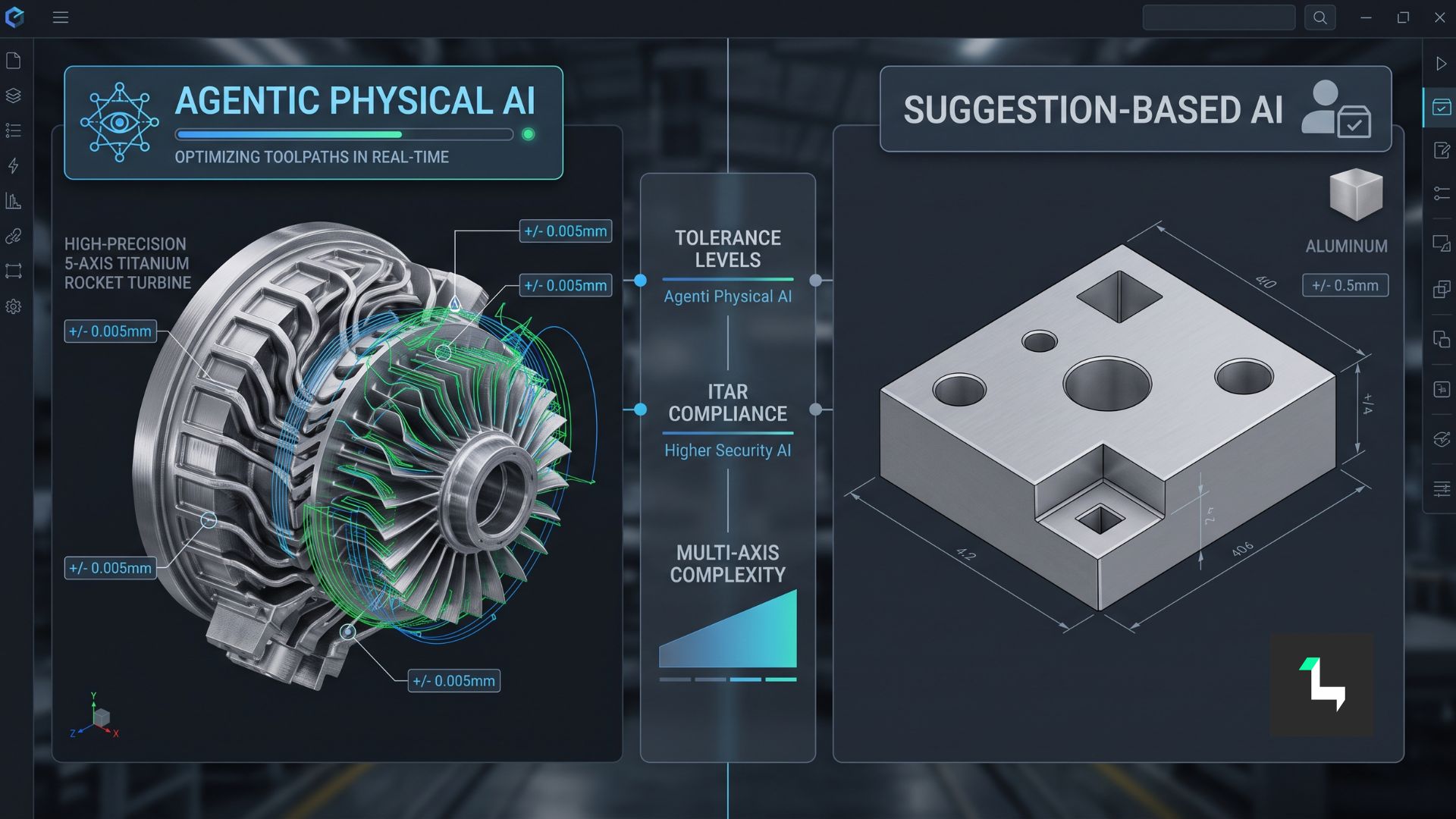
The first model the majority of "AI" features on the market is built on the suggestion paradigm. A language model is connected to the CAM interface, reads part geometry and the programmer's in-progress work, and makes recommendations: which operation to try next, what feeds and speeds to start with, which toolpath strategy to consider.
This is genuinely useful for certain tasks. It reduces clicks on standard milling operations. It helps junior programmers navigate their CAM platform faster. But the limitation becomes apparent when the geometry gets hard. Complex aerospace components with deep pockets, thin walls, undercuts, and tight tolerances require decisions that interact across the entire part. Language models fine-tuned on CAM documentation are pattern-matching on sequences of actions; they have no ground truth understanding of why those toolpaths worked.
This is not a failure of implementation. It is a structural limitation of the approach.
What Physical AI Actually Means
Physical AI is a different category. Where a CAM copilot is built on language understanding applied to manufacturing tasks, a Physical AI system is trained on the geometry, physics, and process constraints that govern how material is actually removed from a part.
When a Physical AI system encounters a deep pocket in titanium with a tight radial tolerance, it does not suggest an operation. It builds a program accounting for the material's tendency to work-harden, the required tool path to maintain consistent chip load, and the need to leave appropriate stock for a finishing pass. It executes that reasoning across the whole part, then produces complete NC code.
“That is not a faster way of doing what a programmer does. It is the programmer function, running at machine speed.”
This is what Limitless Labs means by an AI CAM Agent: a system that takes a part model as input and produces production-ready NC programs as output, operating inside the CAM environments that enterprise manufacturers already run.
The Deployment Architecture Is as Important as the Model
Enterprise manufacturers should ask not just whether an AI tool works, but where it runs. A system that operates natively inside the CAM environment the team already uses will observe the specific programming decisions that make that operation what it is: the feed-and-speed conventions for a given material, the fixturing preferences developed over years, the toolpath standards a senior programmer arrived at through hard experience.
This is why the concept of a foundation model trained on your own manufacturing data matters. General training data does not encode your institutional knowledge. The model that will actually scale your operation is one that learns from your programs, your standards, and your decisions.
Questions to Ask Before You Commit
What data was this model trained on? If the answer is primarily text and documentation, you are looking at a suggestion engine. If the answer includes geometric data, toolpath physics, and manufacturing execution outcomes, you are looking at something different.
Can the system produce a complete NC program from a part model, or does it recommend operations that a programmer must review and finalize? The difference between partial automation and full program generation is significant at scale.
How does the system handle geometry it has not been trained on before? A well-architected Physical AI system reasons from first principles. A suggestion engine degrades toward generic recommendations when it leaves familiar territory.
Does the system learn from your specific programming standards, and who owns that learning? Your institutional knowledge is a competitive asset. That is not a procurement detail it is a strategic one.
Why This Matters at Enterprise Scale
For a precision manufacturer running complex five-axis work across dozens of machines, the distinction between a suggestion engine and a Physical AI agent is the difference between a productivity tool and a capacity expansion. A suggestion engine helps each programmer navigate complexity slightly faster. A Physical AI agent can execute the programming function across the entire landscape — applying institutional knowledge consistently, scaling output beyond what any headcount can achieve.
The aerospace and defense manufacturers currently under pressure to expand domestic production capacity cannot hire their way out of this problem. The operations that will meet delivery commitments over the next five years will be the ones that found a way to scale programming throughput independent of programmer headcount.
At Limitless Labs, we build a Physical AI Foundation Model and CAM Agent for enterprise precision manufacturing running natively inside Siemens NX and Mastercam, learning from your best programmers' decisions, and executing complete NC programs on the full range of parts your operation produces.

