Limitless Labs at IMTS 2026
Booth 237605, North Building Level 3 · Across from Starbucks
Book a MeetingIMTS 2026 is arriving at a different moment than previous editions. AI in manufacturing has moved past the proof-of-concept stage. In the past 18 months, enterprise manufacturers across aerospace, automotive, and industrial machinery have deployed AI CAM tools in production environments and started reporting measurable results: programming time cut from days to hours, junior programmers reaching senior-level output in months, and significant reductions in production errors.
The industry attention at this year's show reflects that shift. A new Industrial AI Arena brings together more than 25 exhibitors focused on applied AI for the factory floor. The first dedicated Industrial AI Conference runs September 16. AI-related content spans robotics, CAM, quality control, digital twins, and production planning.
For manufacturing leaders evaluating solutions at the show, the breadth of the category creates a real evaluation challenge. The approaches differ in meaningful ways, and the right fit depends on the facility's existing CAM environment, the complexity of its part mix, and how the team is structured.
Where AI is delivering results in CAM today
The clearest results have come in three areas: reducing programming time on complex parts, standardizing output quality across programmers at different experience levels, and capturing institutional knowledge so it does not walk out the door when senior programmers retire.
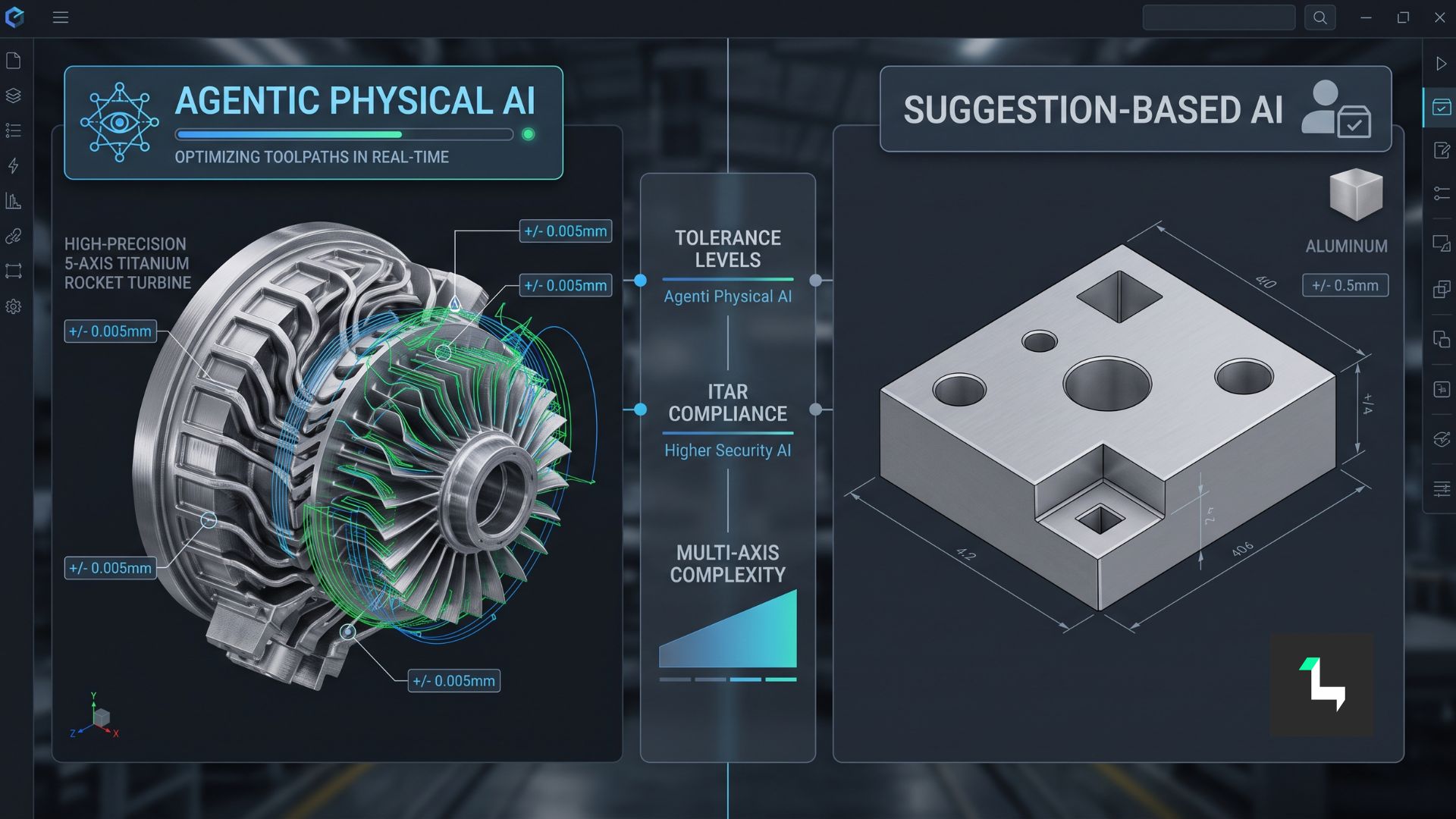
On programming time, tools that automate feature recognition and toolpath generation for common geometries consistently report 40 to 80 percent time reductions. Tools that work on a broader range of complexity, including tight-tolerance aerospace and defense parts, report outcomes in the 50 percent range with higher consistency across the full part mix.
On knowledge standardization, the more significant development has been AI systems that learn from a facility's own best programmers. The institutional knowledge problem in CNC programming is real: senior programmers carry decades of hard-won decision logic in their heads, and that knowledge is not transferable through documentation alone.
“The most durable value in AI CAM is not speed for senior programmers. It is giving the whole team access to senior-level decision-making from day one.”
What varies across approaches
Training data source. Some AI tools are trained on large general datasets. Others learn from a specific facility's own historical programs, tool libraries, and machining standards. The second produces outputs that reflect the facility's specific best practices from the start.
Integration depth. AI CAM tools range from standalone applications requiring file export/import to native plugins that run alongside Siemens NX or Mastercam without workflow interruption. For teams with established CAM workflows, integration depth directly affects adoption speed.
Part complexity range. AI tools optimized for high-volume, lower-complexity parts perform differently on tolerance-critical geometries common in aerospace and industrial machinery. Evaluation on the facility's actual part mix gives the most accurate picture.
Data residency. For manufacturers under ITAR or defense contracts, the location and handling of CAM data is a material consideration.
Five questions for any AI CAM evaluation at IMTS
Can you run a demo on a part from our production floor?
The fastest way to calibrate a system's capabilities is to test it on a representative sample from your own part mix. A 30-minute session on a real STEP file reveals more than an hour of prepared demonstration.
Strong signal: “Yes, bring a file to the booth and we will run it on the spot.”
How does the system learn from our facility's specific standards?
Facilities with established machining standards often find that a system trained on their own data performs better on their part mix than a general model.
Look for: a clear explanation of how the system ingests and applies facility-specific data.
Which CAM environments does it integrate with natively?
Native plugins running alongside Siemens NX or Mastercam generate toolpaths directly in the environment the team already uses, with no file transfer and no context switching.
Confirm: native support for your current CAM environment, with editable outputs.
Where does our CAM data reside during training and inference?
For manufacturers under ITAR or export controls, data residency is a first-order consideration. Asking this early avoids surprises at the security review stage.
Look for: explicit data isolation with documented security controls.
How does it handle junior programmers in a live production environment?
AI tools that encode senior-level decision logic and apply it automatically change the productivity trajectory for junior programmers.
Strong signal: demonstrated capability to apply facility-specific standards regardless of programmer experience level.
What Limitless Labs is demonstrating at IMTS 2026
Booth 237605 · North Building, Level 3 · Across from Starbucks
Live demos on production-representative parts. The Limitless Labs CAM Agent runs natively alongside Siemens NX and Mastercam.
On the booth
- •Live strategy generation alongside Siemens NX and Mastercam, across part samples from multiple industries
- •Full programming output: operations plan, tool selection, cutting conditions calibrated to material and machine
In the meeting room
- •A 30-minute ROI session using your facility's actual programming hours and part mix
Trusted by




Results across production environments
Parts that previously required three to five days of programming are completed in hours. Junior programmers reach senior-level output within months.
IMTS 2026 is a productive time to evaluate AI CAM tools against real requirements. Evaluations on real part samples, with clear questions about integration, data handling, and facility-specific training, give the most accurate picture of fit.
Meet us at Booth 237605
North Building, Level 3, across from Starbucks. Come see the Limitless Labs CAM Agent running live on production parts. We will show you what it does and what it means for your operation. September 14–19, 2026 · McCormick Place, Chicago.
Book a MeetingThe First AI Machinist: Automating CNC, CMM, and DFM End-to-End
David Priev, CEO — Limitless Labs
Monday, September 14 · 1:15–2:10 PM · Room W192-B
Add to my calendar