Somewhere in the last eighteen months, AI CAM crossed from interesting pilot to production reality. One company announced its software is now running in over a thousand manufacturing facilities worldwide. Autodesk made a strategic investment in an AI toolpath startup. Siemens embedded its own machining suggestion engine natively into NX. And Limitless Labs raised $20 million to expand what it calls Physical AI for precision manufacturing, already deployed in production at some of the most demanding facilities in aerospace, motorsport, and industrial tooling.
For manufacturing directors at aerospace, defense, and advanced industrial firms, this news cycle creates a genuine problem. The signal is getting lost in the noise.
The noise says AI CAM is here. The signal says: which AI CAM is ready for your parts? Those are not the same question.
The Problem That Actually Needs Solving
The CNC programmer shortage is not a staffing cycle. It is a structural condition. The most experienced programmers are retiring faster than they can be replaced, the work they do cannot be fully documented, and the backlog for complex parts grows with every departure.
For a manufacturer running general-purpose aluminum components, the constraint is volume and speed. For a manufacturer programming multi-axis titanium components for a next-generation rocket engine, the constraint is the compound knowledge required to correctly identify features, select appropriate tooling, sequence operations safely, generate toolpaths that actually clear, and produce a program that meets tolerance specifications and holds up under ITAR documentation requirements.
That second problem has never been solved by any software tool before. AI CAM, in most of its current commercial forms, is not solving it now.
What the Current Generation of AI CAM Actually Does
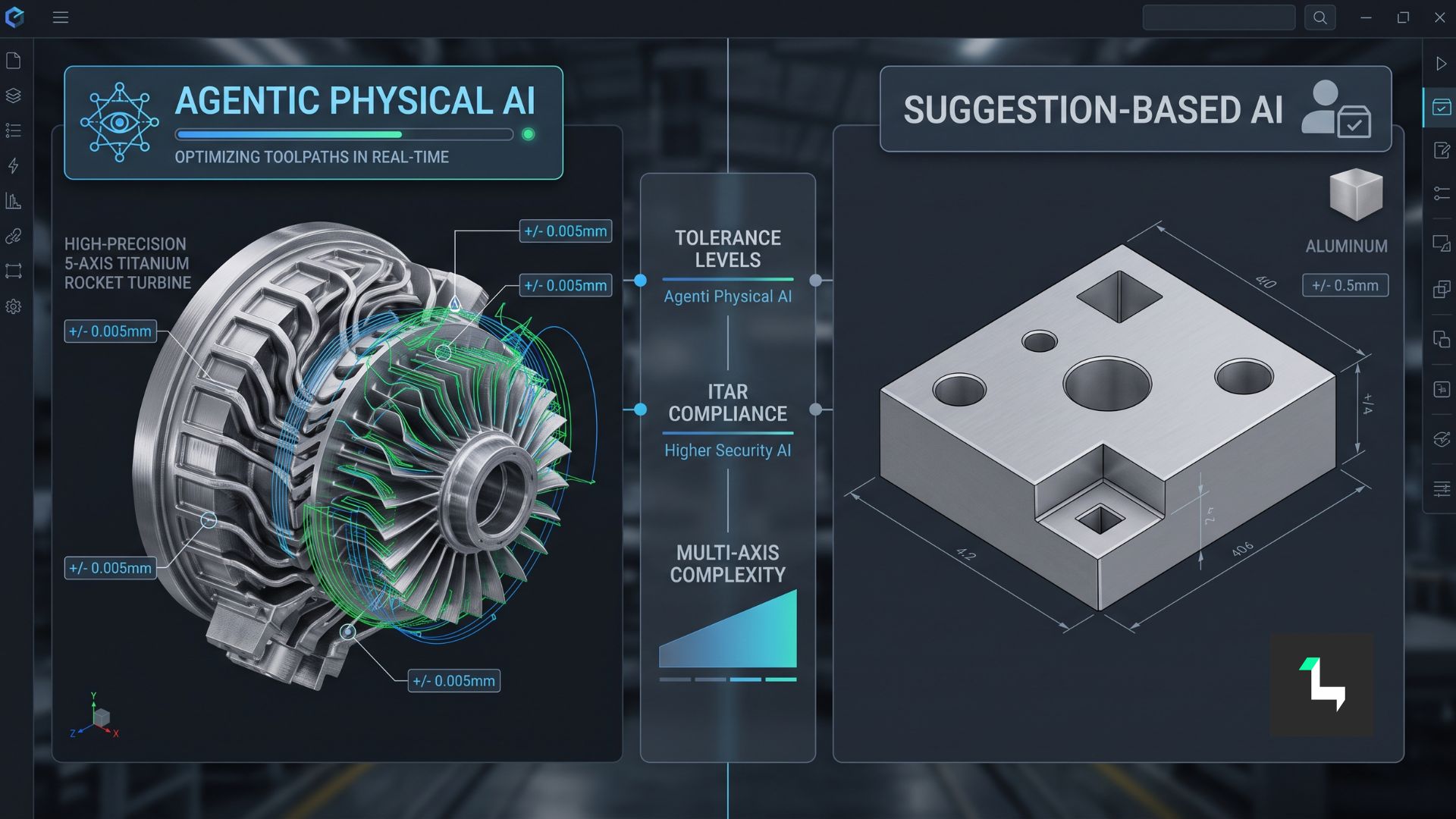
The suggestion-based AI CAM tools released over the last two years have done something real. They surface relevant machining strategies based on geometry recognition. They reduce the time a programmer spends on the first pass of a standard feature. One leading tool in this space now creates up to 80% of toolpaths and cutting strategies for that class of work. A thousand facilities are apparently willing to pay for it.
But the architecture matters. Suggestion-based AI CAM tools operate as an augmentation layer — they recommend, and the programmer decides, modifies, and approves each operation. This human-in-the-loop design is appropriate for the complexity level these tools target. For three-axis prismatic work on standard materials, it is often enough. It is not the architecture required for programming a turbine blade casing, a motorsport suspension component, or a precision cutting tool body with compound geometry.
Why Enterprise Precision Manufacturing Is a Structurally Different Problem
Enterprise precision manufacturing operates at tolerances measured in microns. A programming error that produces a 0.005mm deviation on a general-purpose component is a quality note. The same error on a flight-critical aerospace component is a program stop, a root cause investigation, and potentially a certification reset. The stakes are different by an order of magnitude.
Beyond tolerance, there is compliance. Defense-adjacent manufacturing in the United States operates under ITAR. Any AI system that touches a part program in a regulated environment must be deployable in a controlled environment, auditable, and ITAR-compliant. Most AI CAM tools built for broad commercial access are not architected for this requirement.
There is also institutional knowledge. The most experienced CAM programmers at precision manufacturers have spent years developing an understanding of how their specific machines, tooling, fixtures, and materials behave together. That knowledge is not documented. It lives in the programmer and in the historical programs they have written. When that programmer retires, the knowledge does not transfer automatically.
The Agentic Architecture: What Physical AI Actually Means
Physical AI, as Limitless Labs uses the term, refers to a system trained on the actual physics, geometry, and material constraints of machining — not just what a similar program looked like in the past, but why that program worked given the specific combination of part geometry, tooling, machine kinematics, and material behavior.
In practice, the Limitless Labs agent operates end-to-end inside the CAM system the engineer already uses — Siemens NX, Mastercam, or PTC Creo. Given a CAD file, it identifies machining features, recommends tooling, sequences operations, generates toolpaths, and produces a production-ready program. The engineer remains in control of the final output — not because the AI is uncertain, but because precision manufacturing requires accountability and the engineer owns the part program.
The platform is ITAR-compliant and deployable on AWS GovCloud.
“A two-year-old AI company does not get to full production deployment at these facilities by passing a demo. It gets there by passing qualification.”
The Evidence That Enterprise Manufacturing Directors Should Weight
Limitless Labs is in full production at manufacturers building components for rocket engines, automotive constructors programming to motorsport tolerances, and some of the world's largest producers of cutting tool bodies. A two-year-old AI company does not get to full production deployment at these facilities by passing a demo. It gets there by passing qualification.
The reported outcome is a reduction in CNC programming time of up to 50% in production conditions.
What to Ask Before Evaluating Any AI CAM Tool
The right question is no longer whether AI CAM is ready. It is ready, in at least two meaningfully different forms.
The first is AI-assisted suggestion: tools that reduce programmer time on standard features, work well for three-axis parts, and are appropriate for environments with moderate complexity requirements.
The second is agentic Physical AI: end-to-end automation that operates inside enterprise CAM platforms, learns from an organization's own programming history, meets ITAR and compliance requirements, and is validated on the hardest parts in precision manufacturing.
Manufacturing directors who run the second type of operation and are evaluating the first type of tool are not looking at a solution to their problem.
The question worth asking any AI CAM vendor is not what their average time reduction is. It is what the most complex part is that they have put into production, who made the qualification decision, and where the data runs.
The programmer shortage will continue. The manufacturers who move first on enterprise-grade AI CAM will be the ones whose capacity expands rather than contracts as their workforce transitions. That is no longer a hypothesis. It is already happening in some of the most demanding manufacturing environments in the world.
Limitless Labs builds a Physical AI Foundation Model and CAM Agent for enterprise precision manufacturing. The platform integrates natively with Siemens NX CAM, Mastercam, and PTC Creo. It is ITAR-compliant and deployable on AWS GovCloud.