
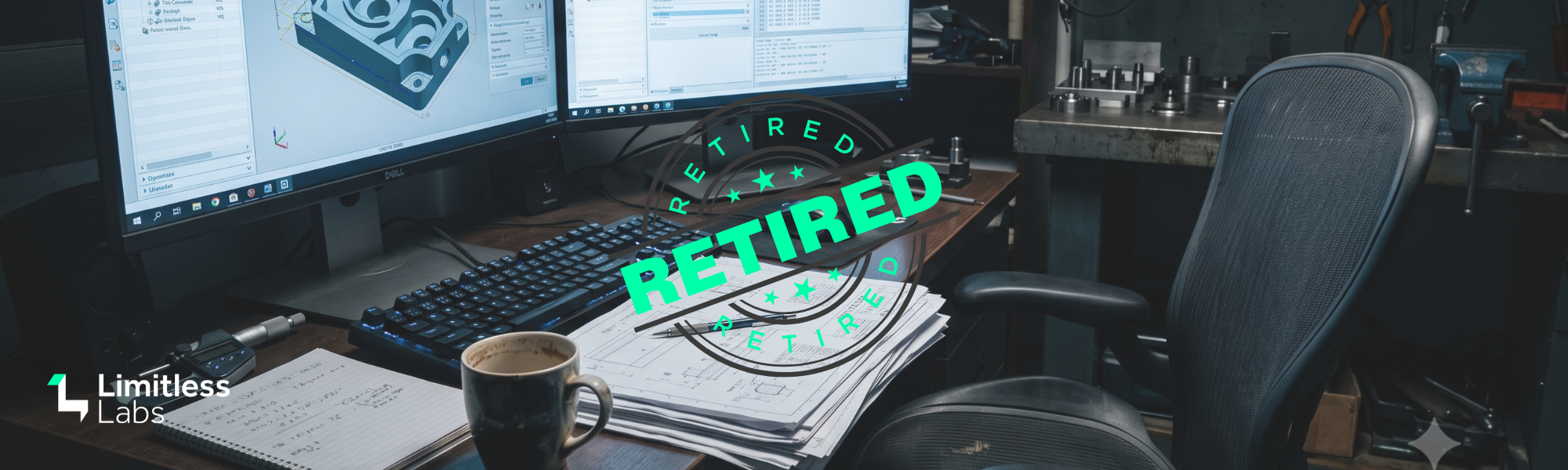
Picture the last week of March. A senior CAM programmer, 25 years at the company, clears his desk. The team throws a small party. Someone buys a sheet cake.
Then, on Monday, three jobs land on the queue that he would have handled. His replacement, eighteen months in, opens the first one in Siemens NX or Mastercam and stares at a titanium structural bracket for a flight-critical assembly. He knows enough to get started. He does not know what his predecessor knew: the specific toolpath sequence that prevents chatter on that particular geometry, the feed rate adjustment that accounts for the thermal drift on the Makino in bay four, the workaround he developed after a scrapped part in 2021 that everyone else has since forgotten.
That knowledge is not in any manual. It was never formally documented. It existed entirely inside one person. Now it is gone.
This is not a dramatic edge case. It is the central operational challenge facing precision manufacturers in 2026. And the industry has not yet grappled seriously with what it will take to solve it.
34,200 openings per year. Every year through 2034. The pipeline is not recovering.
The workforce data on CNC machining is blunt. The Bureau of Labor Statistics projects approximately 34,200 openings annually for machinists and tool and die makers through 2034, driven in large part by retirements and attrition rather than new demand. The U.S. manufacturing workforce is aging faster than the training pipeline is producing replacements. The ACENet program, one of the country's primary machining training initiatives, turned out 420 trainees in 2025 against roughly 15,000 open vacancies.
These numbers are frequently cited in arguments for automation and AI investment. But the framing is usually wrong. The discussion defaults to volume: how do we program more parts with fewer people? That is a real constraint, but it is the secondary problem. The primary problem is expertise.
Expert knowledge does not transfer on its own
A competent CAM programmer is not produced by six months of training. The credential opens the door. The knowledge that makes a programmer genuinely valuable — the pattern recognition, the judgment calls on feeds and speeds for difficult materials, the intuitive grasp of what a particular machine will and will not do — accumulates over years. It compounds. A programmer with ten years of experience is not twice as capable as a programmer with five. He is categorically different.
That expertise is also largely invisible. It does not live in documented processes. It lives in the habits and shortcuts and hard-won corrections that experienced programmers apply automatically, without stopping to explain why. Operations that have tried to formalize this knowledge through structured documentation exercises have learned the same lesson repeatedly: people can describe what they do, but they cannot fully articulate the judgment behind it.
This creates a compounding vulnerability. As senior programmers retire, the knowledge they carry does not transfer through mentorship at the speed required to replace them. The pipeline of new programmers is shorter than the retirement curve. And the programmers who remain are now responsible for more complex work — five-axis machining, tighter tolerances, flight-critical materials — than their counterparts were handling a decade ago.
The shortage is not a temporary market imbalance that will self-correct. It is a structural feature of the industry's demographic trajectory.
Faster programmers do not solve a shortage of programmers
The AI tools that have entered the CNC programming market over the past few years share a common framing. They describe themselves as copilots: AI-assisted suggestions that help programmers work more quickly. A programmer opens a CAD file, the tool proposes a strategy, the programmer reviews and adjusts.
This is genuinely useful. A programmer who generates a first-pass toolpath in ten minutes instead of forty-five is meaningfully more productive.
But the copilot model does not address the knowledge problem. It makes fast programmers faster. It does not capture what experienced programmers know. It does not reduce the dependency on expert judgment. It assumes expert judgment is present and helps it operate more efficiently. When the expert is gone, the tool is less valuable, not more.
The structural problem is not keystrokes. It is that the decision-making architecture of an expert programmer — the knowledge of what to do and not just how to do it — has no durable home in the current operating model.
The difference is what the model was trained on
What distinguishes an AI agent built for physical manufacturing from a copilot tool is the model underneath it. Pattern-matching tools are trained primarily on process sequences and user behavior. They learn from what programmers have done. That makes them effective at accelerating familiar workflows.
A Physical AI Foundation Model starts from a different premise. It is trained on the physics of metal cutting: CAD geometry, material behavior, machine kinematics, and real manufacturing constraints. The model does not observe how programmers work and try to approximate their behavior. It understands why certain decisions are correct given the geometry, the material, the machine, and the operation type.
Copilot tools
- •Trained on process sequences and user behavior
- •Accelerate familiar workflows
- •Depend on expert judgment being present
- •Lose value when the expert is gone
Physical AI agent
- •Trained on the physics of metal cutting
- •Reasons about geometry, material, machine, and operation
- •Produces expert-level baselines
- •Preserves judgment inside the model
That distinction matters when the part is difficult, the material is unforgiving, and the margin for error is measured in thousandths of an inch. In those environments — in aerospace, defense, and precision industrial machinery — pattern approximation is not sufficient. The model has to understand the underlying physics.
A CAM Agent built on this foundation works inside the environments programmers already use — Siemens NX or Mastercam — reading the CAD file, identifying features, recommending tooling, sequencing operations, setting feeds and speeds, and generating a shop-floor-ready program. The programmer sees every decision. Nothing is a black box. The agent produces the baseline; the engineer reviews, adjusts, and approves. What changes is the quality and speed of that baseline, which now reflects expert-level judgment rather than starting from scratch. See the technical overview of the platform for how the foundation model is built and integrated.
This is running on real parts, in production environments
The question that matters to a manufacturing director is not whether the technology is theoretically sound. It is whether it runs in production on real parts.
Physical AI agents are in production today at Tier 1 aerospace manufacturers, Tier 1 motorsport programs, and leading precision tooling companies. These are not pilot programs or controlled proofs of concept. They are production-integrated, running on actual manufacturing workflows, generating the programs that cut actual parts. Explore the Tier 1 deployments and case studies for detail on how these programs run day to day.
“The programmers who remain can focus on the cases that genuinely require human judgment. The agent handles the volume.”
The reported reduction in CAM programming time is up to 50 percent.
The significance of this for the knowledge problem is straightforward. The agent handles the standard and mid-complexity programs — the work that currently consumes most of a senior programmer's day. That frees the expert to focus on the genuinely hard problems: the parts that push the limits of the machine, the materials that leave no margin for error, the edge cases that require real engineering judgment. The operation does not lose its experts to routine work. It directs them where they are actually needed.
The real risk is not cost per part. It is business continuity.
Manufacturing directors who think about AI investment through a cost-per-part lens are asking the wrong question. The more important calculation is what happens to throughput capacity when senior programmers retire.
Consider a precision manufacturing operation with three experienced CAM programmers handling the complex work: multi-axis, difficult materials, tight tolerances. Two of them are within five years of retirement. Replacing them means finding candidates in a market where experienced programmers are scarce, onboarding them against an eighteen-to-twenty-four-month learning curve, and accepting that throughput on complex work will decline during that transition.
An AI agent that handles standard and mid-complexity programming changes this calculation. Senior programmers are no longer spending the majority of their time on work the agent can do. They focus on the genuinely complex challenges: the parts, materials, and edge cases that require real expertise. New hires reach productive contribution faster because they are reviewing and refining rather than generating from scratch. The operation's capacity for complex work does not shrink when senior programmers retire. It is protected.
This is not a productivity story. It is a business continuity story. The operations that recognize this distinction and act before the retirement wave arrives will be in a categorically different position than those that respond reactively.
The question most enterprise operations are not asking
The CNC programmer shortage will not be solved by the training pipeline. The math does not work. The retirement rate exceeds the graduation rate, and the complexity of the work being asked of new programmers is rising, not falling.
The question manufacturing directors should be asking is not how to hire more programmers. It is how to ensure that the programming knowledge their business depends on outlives the individual programmers who currently carry it.
Physical AI, built on a foundation model trained on the actual physics of machining, is the first credible answer to that question. Not a faster version of the current model. A different model entirely.
The senior programmer who retired in March took 25 years of knowledge with him. That does not have to be the story of the next retirement, or the one after that.
See the CAM Agent in a production environment
Watch how Tier 1 aerospace, defense, and motorsport manufacturers are deploying the Limitless Labs CAM Agent inside Siemens NX and Mastercam today.
Book a demo